A 2024 industrial safety benchmark study found that sites using real-time location tracking saw a 38% reduction in lost-time injuries and a 27% drop in safety incidents within the first year of deployment — outcomes HSE leaders in oil & gas, mining, and construction cannot ignore.
Safety isn’t a slogan. In high-hazard industries, it’s a measurable discipline that dictates survival, productivity, and reputation.
Today’s most forward-thinking HSE leaders aren’t waiting for incidents to occur. They’re using a workforce tracking system, powere d by real-time location tracking and advanced sensors to prevent harm before it occurs and to strengthen compliance management across complex job sites.
The Safety Imperative in High-Risk Industries
Workforce safety has evolved from checklist compliance to continuous risk of visibility. Traditional methods — headcounts at muster points, manual safety rounds, paper logs — are no longer sufficient where operations span acres, go deep underground, or extend offshore. Leaders need situational awareness that matches the pace of change on the ground.
Modern workforce tracking system technologies provide awareness. These systems combine precise position data with environmental and physiological sensors to create real-time safety intelligence — not just historical incident reports.
Real-world research reinforces this shift. A study published in Safety Science found that real-time tracking significantly improves hazard recognition and reduces response times in industrial environments.¹ This isn’t future talk. It’s happening now on construction of megaprojects and major oil & gas facilities.
How Real-Time Location Tracking Enhances Safety
At its core, real-time location tracking eliminates uncertainty. In oil & gas plants, mining tunnels, and construction zones, knowing where people are — and where they shouldn’t be — is vital.
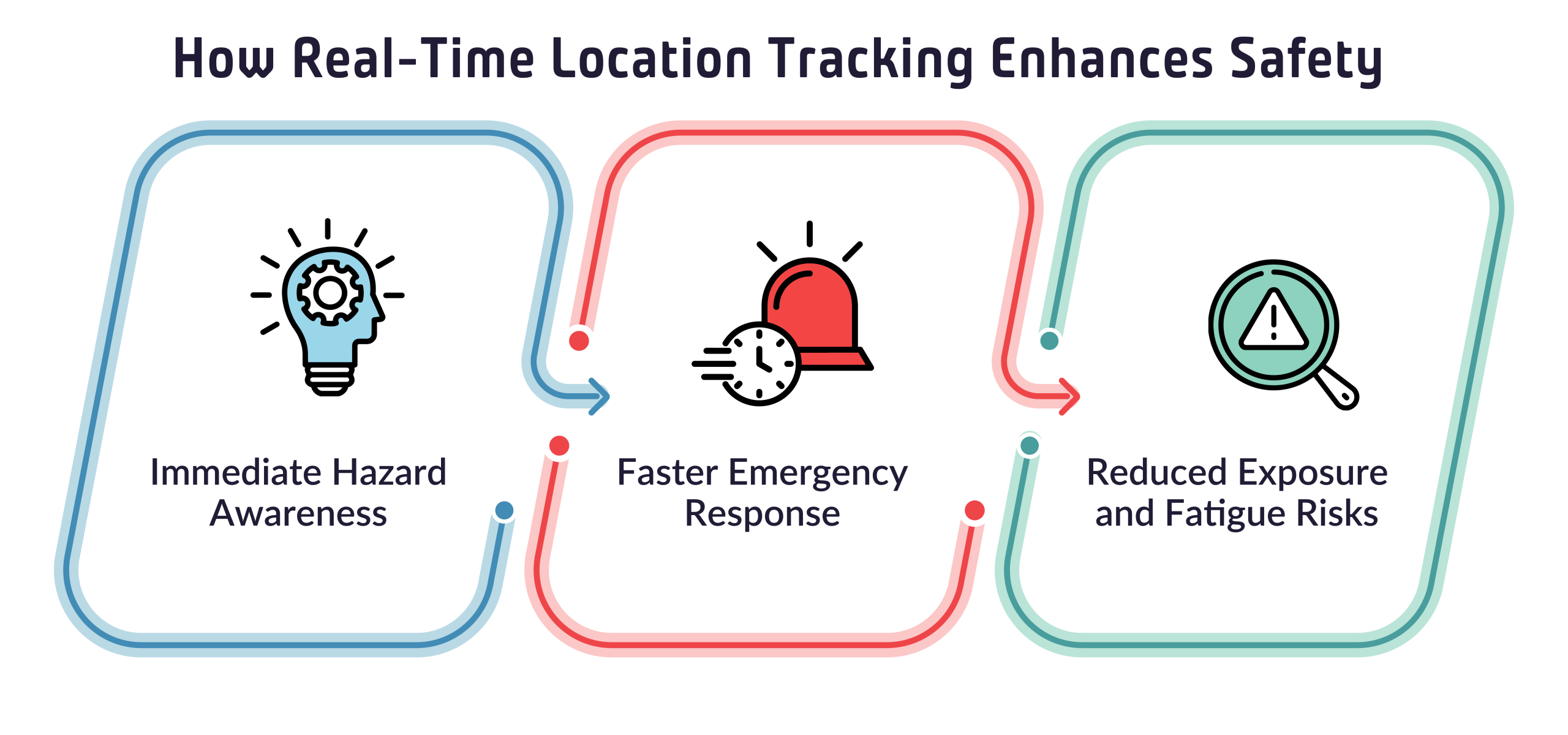
1. Immediate Hazard Awareness
Sensors paired with location tracking can detect dangerous conditions — gas leaks, temperature spikes, unstable terrain, and alert nearby workers instantly. A paper in Journal of Loss Prevention in the Process Industries highlights that integrating location tracking with environmental sensors meaningfully reduces near-miss events.
2. Faster Emergency Response
When the unexpected happens, every second matters. Traditional roll calls and manual searches waste time. With real-time location intelligence, rescue teams know exactly who is in the hot zone, who has evacuated, and where help is needed first. A global mining operator reported cutting average emergency response time by 30% after deploying a real-time workforce tracking system.
3. Reduced Exposure and Fatigue Risks
Tracking isn’t just about proximity; it’s about patterns. Systems that monitor movement trends help identify workers at risk of fatigue or prolonged exposure to hazards. Organizations using these insights report fewer lost-time incidents and improved worker wellbeing.
Elevating Employee Safety Monitoring from Reactive to Predictive
A significant limitation of legacy safety programs is that they are reactive. They measure what went wrong, not what might go wrong.
Enter employee safety monitoring through continuous data streams. Modern systems track physiological signals (heart rate, temperature), motion irregularities, and environmental context. Coupled with location, this allows predictive alerts — for instance, identifying a worker in a heat-stress zone before symptoms appear.
Research from Applied Ergonomics shows that predictive monitoring systems can reduce workplace injuries by enabling early interventions, especially in environments with high heat, vibration, or toxic exposure.
Strengthening Compliance Management with Data Integrity
Regulatory bodies increasingly demand traceable proof of compliance, not just signed forms. A workforce tracking system delivers documented evidence of safe practices:
- Time-stamped entry/exit logs for confined spaces
- Verified location trails during high-risk operations
- Automated reporting for audits and regulatory reviews
- Digital records of safety zone breaches and corrective actions
This shift from manual recordkeeping to digital compliance data not only reduces risk but also improves operational transparency — a competitive advantage in industries where liability and reputation are tightly linked.
A Strategic Adoption Framework for HSE Leaders
To derive true value from real-time tracking and monitoring systems, HSE leaders should think beyond technology implementation. The most successful adopters follow three principles:
Align with Critical Safety Outcomes
Start by defining measurable safety KPIs — reduced excursion events, faster muster confirmation, or fewer hazardous exposure incidents — and design the system to deliver on them.
Integrate Across Operational Systems
Connect real-time data with incident management, training records, and maintenance systems. Integration strengthens both employee safety monitoring and compliance management by creating unified, actionable data flows.
Prioritize Human-Centered Alerts
Too many alerts become noisy. Configure thresholds to minimize false alarms while ensuring timely warnings for real threats.
Closing the Gap Between Safety Vision and Reality
For HSE leaders in oil & gas, mining, and construction, safety and compliance are long-term commitments, not checkbox exercises. A robust workforce tracking system, underpinned by real-time location tracking, transforms adherence from obligation to insight. With predictive employee safety monitoring and automated compliance management, organisations not only respond to incidents, they also prevent them.
The evidence is clear: real-time tracking solutions are no longer optional, they are strategic infrastructure for resilient, safe, and compliant industrial operations.
Enhance workforce safety with Tracklynk’s real-time visibility and advanced incident prevention. Discover how top HSE teams are transforming operations with data they can truly rely on.
Book a product demo today and learn more about the product here.